UNCATEGORIZED · 24 Sep 2026
Poland registers 970 new battery-electric buses in eight months as zero-emission share reaches 37.5 percent
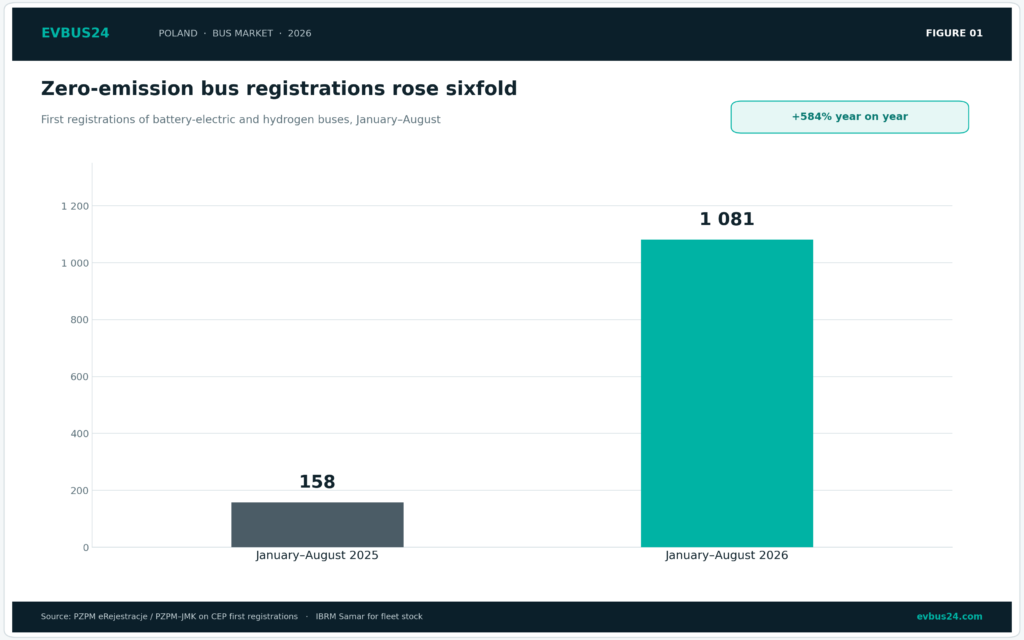
First-registration data from PZPM show battery-electric and hydrogen buses accounting for more than a third of the new-bus market through August 2026, against a contraction in passenger BEV demand.
The Polish electromobility debate in 2026 has been dominated by passenger cars. New battery-electric passenger registrations have declined for several consecutive months following the end of purchase incentives, and that decline has shaped most public commentary. The bus market has followed a different course.
According to the Polish Automotive Industry Association’s eRejestracje series, compiled from Central Vehicle Register first registrations, and the joint PZPM/JMK analysis of the new-bus market for January–August 2026, Poland registered 970 new battery-electric buses in eight months. Including 111 hydrogen fuel-cell vehicles, first registrations of zero-emission buses reached 1,081 units. In the corresponding period of 2025 the total was 158. That is an increase of 584 percent.
The first half of 2026 alone accounted for 713 to 715 battery-electric buses (depending on whether the source is PZPM’s June eRejestracje summary or the PZPM/PSNM Licznik Elektromobilności published on 20 July). Either figure is more than twice the volume recorded for the whole of 2025.
Drivetrain mix
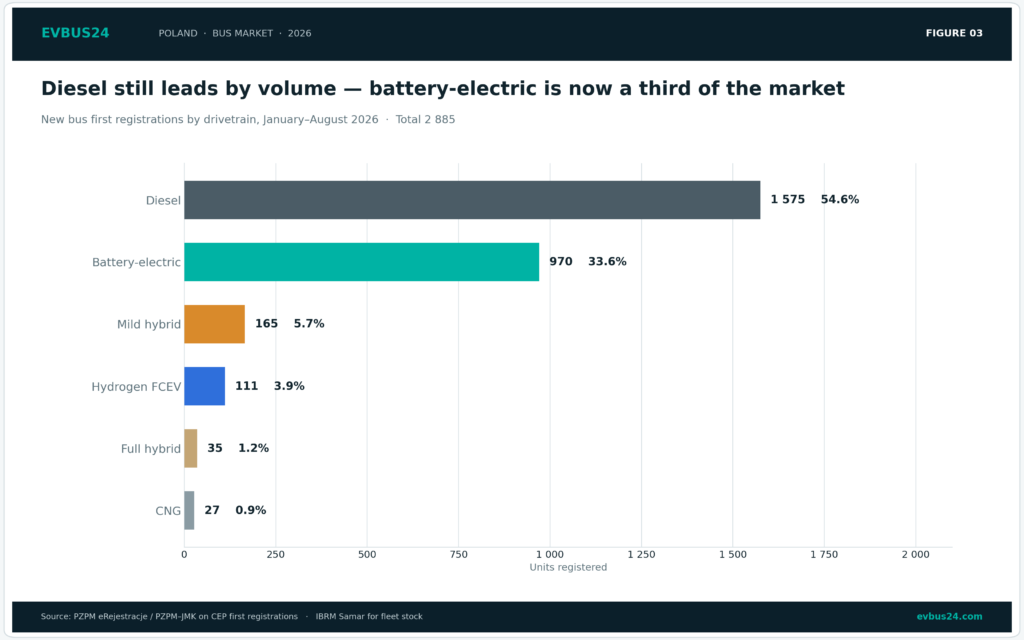
The increase is not an artefact of a shrinking overall market. Poland registered 2,885 factory-new buses in the first eight months of 2026, 75 percent more than the 1,649 units recorded a year earlier. Diesel remains the largest single drivetrain, at 1,575 units or 54.6 percent, but its share has fallen from 84 percent in January–August 2025.
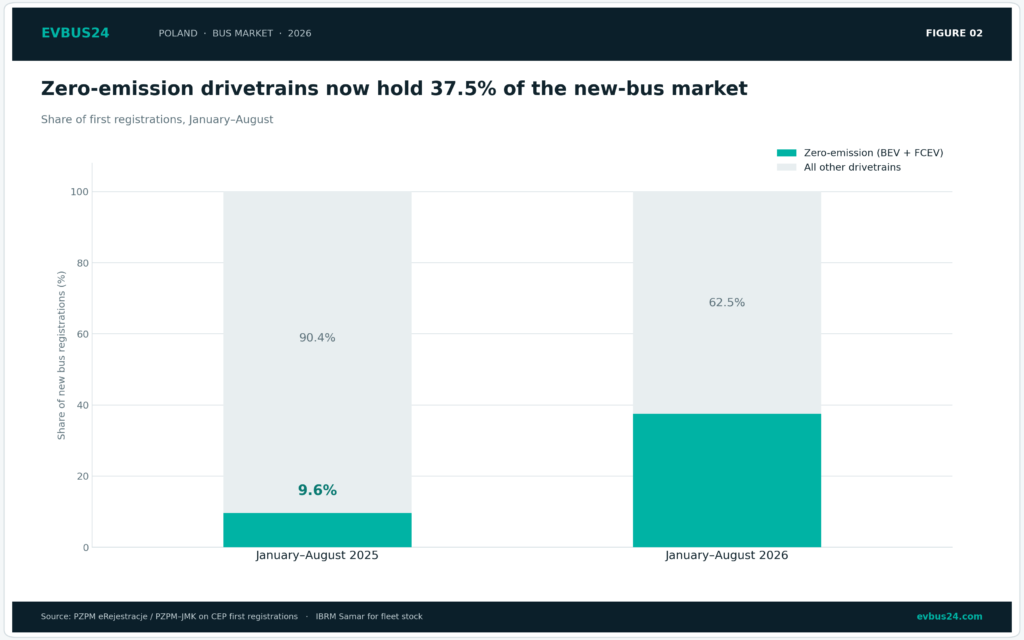
Battery-electric buses now represent 33.6 percent of new registrations. Hydrogen accounts for a further 3.9 percent. Combined, zero-emission drivetrains hold 37.5 percent of the new-bus market, compared with 9.6 percent a year earlier.
Monthly profile
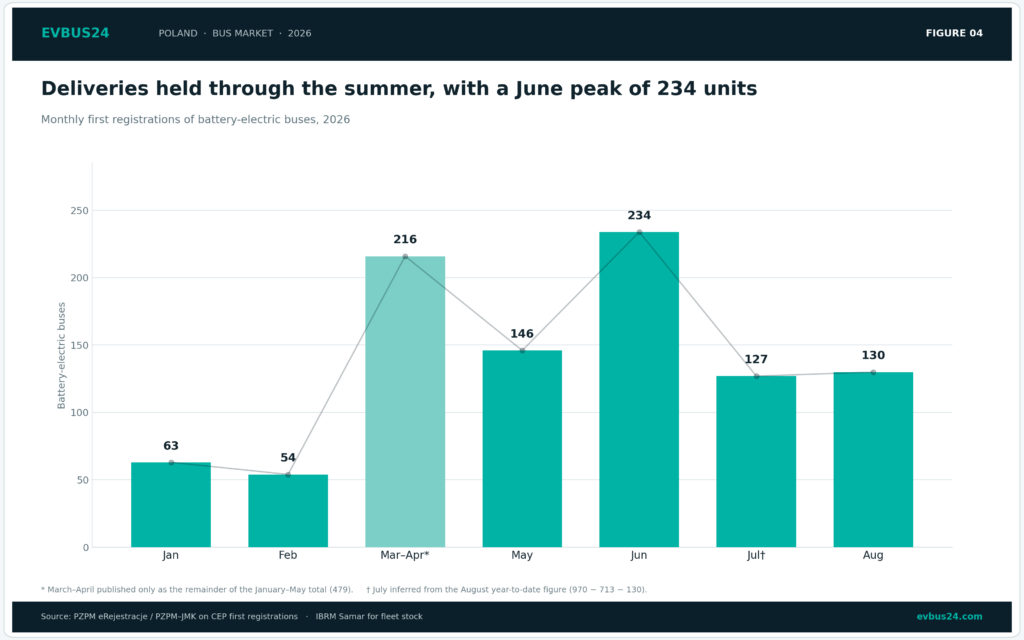
In previous years, electric-bus deliveries in Poland were often concentrated in the final quarter, when tender awards and subsidy deadlines coincided. The 2026 profile has been more even. January recorded 63 battery-electric buses and 11 hydrogen vehicles. February added 54 battery-electric units, against six in February 2025. By the end of May the year-to-date battery-electric total stood at 479. May itself reached 146 units, compared with 30 a year earlier.
June set a further monthly high. PZPM recorded 234 electric-bus registrations in that month and reported that zero-emission drivetrains exceeded 50 percent of the bus category. Volumes did not fall away in the third quarter. The August eRejestracje infographic shows 130 battery-electric buses and five hydrogen buses, bringing the eight-month totals to 970 and 111 respectively. On the published cumulative figures, July is consistent with approximately 127 battery-electric units.
Urban buses account for most of the increase. The city segment recorded 1,437 registrations in eight months, a rise of 359 percent, and now represents half of the new-bus market. The leading model in that class is the Solaris Urbino 12 electric, with 348 units. Electrification is also visible in the intercity segment: of 232 intercity buses registered this year, 71 were battery-electric. Touring coaches remain almost entirely diesel.
Fleet in service
First registrations measure inflow. The in-service fleet is the relevant figure for network planning. The joint PZPM/PSNM electromobility counter placed Poland’s zero-emission bus fleet at 1,854 vehicles at the end of 2025 (1,731 battery-electric and 123 hydrogen). By the end of June 2026 the fleet had increased to 2,647 — 2,444 battery-electric and 203 hydrogen. IBRM Samar, using CEPiK data adjusted for deregistrations, reported 2,520 battery-electric buses at the end of July and 2,655 at the end of August, approximately 76 percent above the August 2025 level of 1,515.
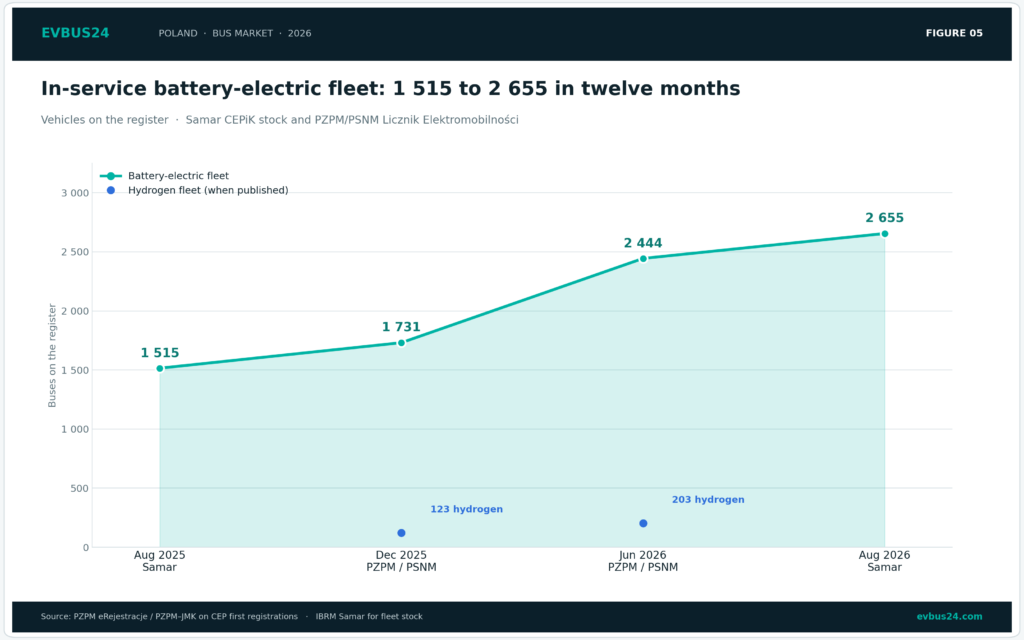
Jan Wiśniewski, director of the PSNM research centre, attributed the acceleration in July to vehicles ordered under the Green Public Transport programme and under European Union co-financing, now entering municipal fleets. “That produced a rise in battery e-bus registrations of more than 600 percent year on year. The number of such vehicles in the first half grew by 715 units. That is more than twice the whole of 2025.” Jakub Faryś, president of PZPM, noted the divergence with the passenger-car market, where plug-in hybrids have overtaken battery-electric cars on the register, while “the number of electric buses is growing very dynamically — 2,647 of them are already on our streets, of which 203 are hydrogen.”
Policy and procurement
Two regulatory and funding conditions explain the timing. From January 2026, Polish cities with more than 100,000 inhabitants may purchase only zero-emission buses for public-service fleets. The rule applies to the municipalities that dominate urban demand. In parallel, National Recovery Plan (KPO) funding and the Green Public Transport programme have been converting contracted orders into deliveries. Industry notes issued in late 2025 referred to almost 1,800 buses contracted under KPO, including 1,159 urban battery-electric and hydrogen vehicles under Green Public Transport. eRejestracje records completed first registrations, not contract announcements. Those registrations are now visible in the monthly series.
Supplier shares are shifting with the drivetrain mix. Mercedes-Benz remains first in the overall new-bus ranking, with 837 units and 29 percent of the market, largely on the strength of the Sprinter in the mini segment. Its share has nonetheless declined from 41.7 percent. In the urban class, Solaris recorded 762 registrations, an increase of 491 percent, based on the Urbino electric range. Vehicles produced in Poland accounted for 974 of the 2,885 new buses, one third of the market, compared with 16 percent a year earlier. Yutong, which registered 11 units in the corresponding period of 2025, has reached 135 in 2026.
Divergence from the passenger-car market
New passenger battery-electric cars fell 34 percent year on year in August 2026, to 2,189 units, and their market share declined from 7.8 percent to 4.8 percent. The usual explanation is the closure of the NaszEauto incentive and a high comparison base in 2025. Household demand can be deferred. Municipal replacement cycles cannot. Cities are operating under a statutory purchase restriction, a delivery timetable and co-financing rates that cover a substantial share of a vehicle that still costs close to three times the equivalent diesel bus.
That dependence is also the principal risk. Volumes at this level rest on contracts already awarded. Delayed KPO disbursement, or a late opening of subsequent FEnIKS and national funding windows, would affect the 2027 registration profile. Depot charging remains the operational constraint that registration totals do not capture. Poland had 13,201 publicly accessible charge points at the end of June, almost half of them DC. That network is relevant to passenger cars. Overnight charging of a 12-metre urban bus is a depot-infrastructure question, and the operators able to sustain current volumes will be those completing substations and yard works in the coming winter.
Indicators for the remainder of 2026
| Indicator | 2025 reference | Latest 2026 figure |
|---|---|---|
| New BEV buses, Jan–Aug | within 158 ZE total | 970 |
| New FCEV buses, Jan–Aug | — | 111 |
| New ZE buses (BEV+FCEV), Jan–Aug | 158 (9.6% share) | 1,081 (37.5% share) |
| All new buses, Jan–Aug | 1,649 | 2,885 (+75%) |
| New BEV buses, first half | well below 2025 full year | 713–715 (>+600% y/y) |
| August BEV / FCEV registrations | — | 130 / 5 |
| ZE fleet, end-2025 | 1,854 (1,731 BEV + 123 H2) | — |
| ZE fleet, end-June 2026 | — | 2,647 (2,444 BEV + 203 H2) |
| BEV fleet, end-August 2026 (Samar) | 1,515 (August 2025) | 2,655 (~+76% y/y) |
The fourth quarter will indicate whether 2026 is an isolated delivery peak or a new run-rate. Three points are material for fleet planning. First, whether the 130 battery-electric units recorded in August represent a seasonal easing or the underlying monthly level; a fourth quarter in line with June would take the annual battery-electric total above 1,400 units. Second, how much of the remaining KPO urban allocation is registered before the relevant settlement deadline. Third, whether Yutong’s 135 units reflect a small number of discrete tenders or a broader diversification of supply among municipal buyers that have historically concentrated orders with Solaris.
For public-transport authorities and operators comparing electric-bus specifications, the Polish registration file for 2026 is evidence that a purchase mandate, committed co-financing and a domestic manufacturing base can move volumes independently of the passenger-car incentive cycle. Consumer BEV demand has softened. Public-service fleet replacement has not.
Sources
- PZPM eRejestracje monthly releases and August 2026 infographic (CEP first registrations): www1.pzpm.org.pl/pl/Elektromobilnosc/eRejestracje
- PZPM and JMK Analizy Rynku Transportowego, first registrations of new buses, January–August 2026
- PZPM/PSNM Licznik Elektromobilności, 20 July 2026
- IBRM Samar, electric-bus fleet notes, July and August 2026
- European Alternative Fuels Observatory, Poland 2025 review
Monthly battery-electric volumes for March–April and July are reconstructed from official cumulative totals where PZPM did not publish a separate monthly BEV-bus line. CEP figures are subject to revision.