UNCATEGORIZED · 26 Sep 2026
Electric school buses – range is not the problem
Electric school buses: range is not the problem, and winter is not the problem either
More than 8,500 electric school buses are already running in the United States. Polish rural communes have been sending children to class in battery “gimbus” since 2020. Canadian pilots in Edmonton and Calgary kept more than twice the range they needed at −30 °C. The remaining argument is no longer physics it’s the entire programme arrangement.
Every weekday morning a yellow, orange or municipal bus stops outside a school. For most of a century that vehicle has burned diesel. The exhaust sits at the height of a child’s face. The engine idles while the driver waits. The cabin is noisy. In a cold snap the diesel itself can gel, and the bus that was supposed to collect children does not start.
I remember it almost exactly like that when I visited Florida and drove in a rented convertible car. With a roof folded down all the fumes from the nearby yellow school bus were hitting me in my face. That’s when it hit me immediately, why school buses, especially in warm environments, can’t be all electric?
It turns out that after doing some research, there are thousands of electric school buses deployed already. And even in the areas with harshes winters.
A battery-electric school bus is the same vehicle with a different powertrain. It still has a driver, seats with belts, a stop-arm and a duty cycle built around two peaks: a morning run and an afternoon run, with a long parked interval in the middle and another overnight. That duty cycle is why school transport is one of the easiest heavy-vehicle jobs to electrify. The bus is not a long-haul coach. It is a neighbourhood appliance that returns to the same yard every day.
This briefing is written for parents, school-board members and local officials who are not fleet engineers. It walks through what the vehicles actually do, why range anxiety does not match the timetable, why winter operation works when the heating strategy is planned, and what school officials in the United States, Canada, Poland and other European countries have said after they put the buses on the road.
What is an electric school bus?
An electric school bus is a school bus whose traction motor is fed by a high-voltage battery pack instead of a diesel engine and fuel tank. In North America the familiar yellow Type C “conventional” and Type D “transit-style” bodies are now offered by several manufacturers with packs that, depending on the model year, are typically in the 150–300 kilowatt-hour range.
In Europe the equivalent vehicle is often a 12-metre low-floor or low-entry city bus adapted for pupil transport, or a purpose-built midibus under eight metres for smaller communes. Poland’s orange “gimbus” is usually a Solaris Urbino 12 electric with belts on every seat. In Italy, Campania’s current programme uses 7.6-metre Iveco eDaily minibuses with a wheelchair lift.
The driver still sits at the front. The children still sit in rows. What disappears is the diesel combustion engine: no tailpipe nitrogen oxides, no diesel particulate matter, no engine roar, no overnight engine block heater fighting to keep oil liquid at -20 °C.
In Electric school bus the regenerative braking feeds energy back into the pack when the bus slows for a stop. Overnight, or during the long midday dwell, the bus plugs into a depot charger. Most school yards do not need a highway-style fast charger. A 19-kilowatt Level 2 unit, left on for six to eight hours, covers the great majority of routes.
That last point is the one that surprises people who have only driven an electric car on a motorway. A passenger car is asked to do unpredictable trips. A school bus has pre-planned routes, five days a week, nine or ten months a year. The energy problem is therefore a planning problem, not a mystery.
What is the range of electric school bus?
The most common objection is still “but will it make it home?” The published route data say that it will, with a large margin.
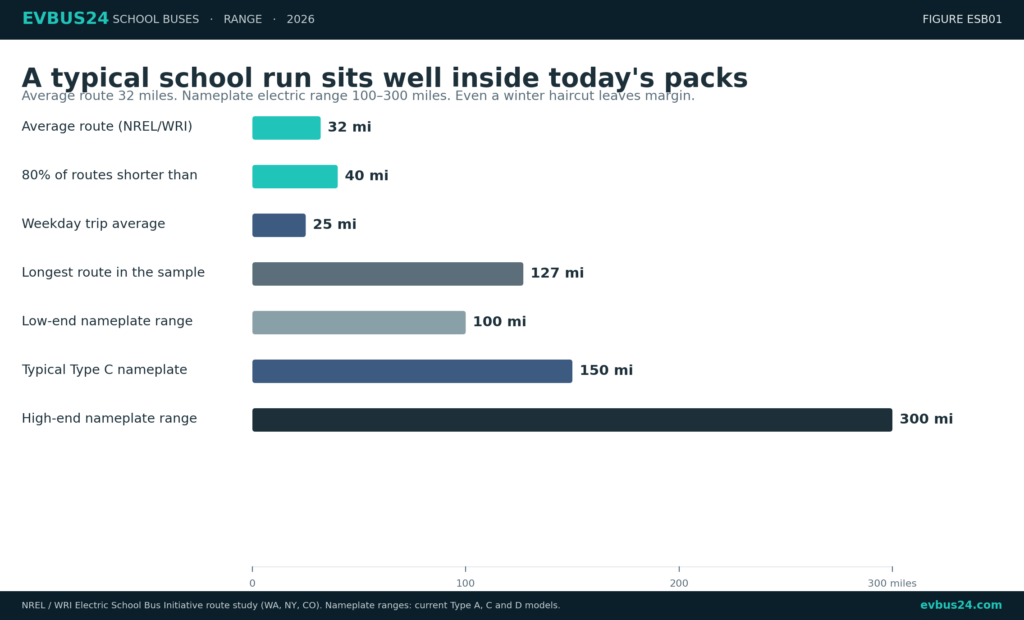
The World Resources Institute’s Electric School Bus Initiative, drawing on a National Renewable Energy Laboratory study of routes in Washington, New York and Colorado, put the average school-bus route length at 32 miles, about 51 kilometres. Eighty percent of the routes in that study were shorter than 40 miles. The longest route in the sample was 127 miles. Nameplate ranges on current Type A, C and D electric school buses sit between 100 and 300 miles. Even during a winter, a 150-mile bus still covers a 32-mile loop twice in a day and has energy left over.
A 2025 U.S. Department of Energy analysis of real telematics went further. Weekday school-bus trips averaged about 25 miles. Morning runs averaged 26.9 miles, afternoon runs 23.2 miles. 58% of weekday trips were under 25 miles. The researchers’ modelling conclusion was blunt: more than 90% of the U.S. school-bus fleet could be electrified with current battery sizes and ordinary 19.2-kilowatt depot charging, without changing existing operating patterns. The edge cases – weekend sports trips over 150 miles, or a rural high-mileage contract – need a larger pack or a midday top-up.
Minnesota’s state planning note for districts puts the same arithmetic in plainer language. A typical electric school bus travels 100 to 120-plus miles on a full charge, “suitable for more than 90 percent of all school bus routes in the United States.” Heating and air-conditioning reduce range – the note uses 25 percent for heat and 15 percent for cooling-but “since the average U.S. school bus route is 35-40 miles, electric AC and heat range reductions are usually inconsequential.”
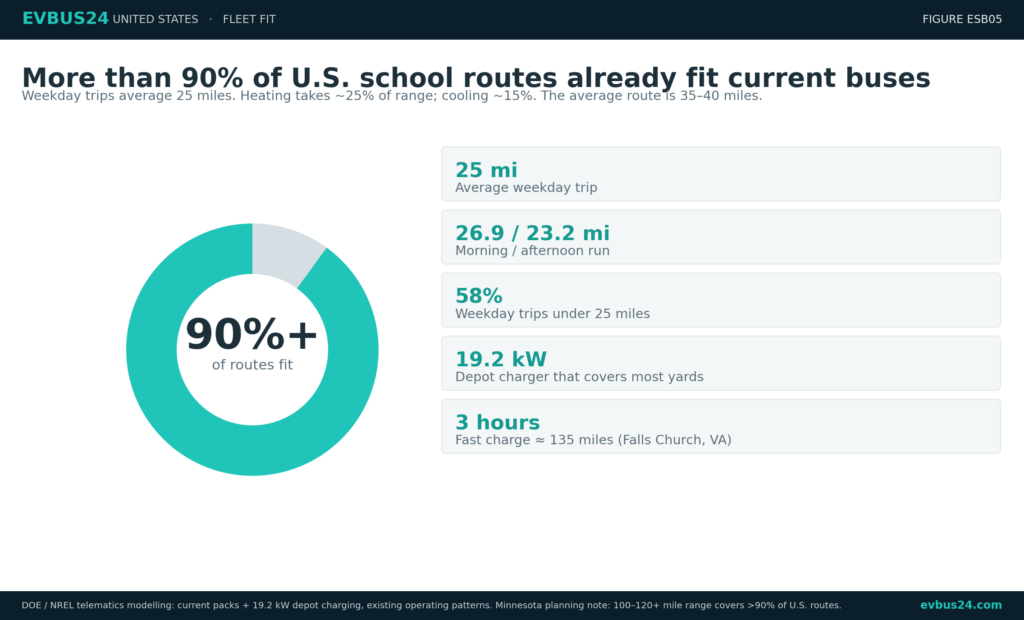
Falls Church City Public Schools in Virginia has reported that a three-hour fast charge is enough for about 135 miles. Cajon Valley Union School District in Southern California bought early buses quoted at 100–120 miles and saw 70-100 miles in real service once air-conditioning and passenger load were included. That is still more than a typical double run. The lesson from Cajon Valley is not that the technology failed. It is that a district should specify the pack against the worst week of the year.
Rural routes are the honest test, because they are longer. Three Rivers Community Schools in southwest Michigan assigned electric buses to its longest duties, including a 92-mile day. Salt Lake City did the same on routes through neighbourhoods with the worst air quality. Both districts completed the work. Midday charging between the morning and afternoon peaks is available on almost every school timetable. The electric school bus, or any other school bus, stays unused for several hours.
Electric school buses range in winter
Cold weather is the second objection, and it is the one that sounds scientific. Batteries are less willing at -20 °C than at 15 °C. Cabin heat on an electric vehicle comes from the same pack that moves the wheels, unless the operator fits a small auxiliary heater. Both statements are true. Neither is an argument against using the bus for school work.
What matters is the margin. A school route that needs 30 miles or 55 kilometres on a bus that still delivers 70 miles or 111 kilometres on its worst recorded winter day is not a range crisis. That is the Edmonton result.
Between April 2024 and April 2025, Pollution Probe, Mobility Futures Lab and RFS Energy followed a 77-passenger Lion Electric Type C with a 126-kilowatt-hour pack on 298 trips in Edmonton, Alberta. The operator was Rental Bus Lines. The bus used an auxiliary diesel cabin heater, which is common industry practice and is the configuration most districts actually buy. Energy intensity rose from 0.73 to 0.82 kilowatt-hours per kilometre between autumn and winter, a 12 percent increase.
On the worst observed day, with air temperature down to −30 °C, energy use reached 0.98 kWh/km against 0.62 kWh/km on the best day – a 58% swing. Regenerative braking recovered about 20 percent of energy across all trips. Charging power dipped by only about 10% in extreme cold.
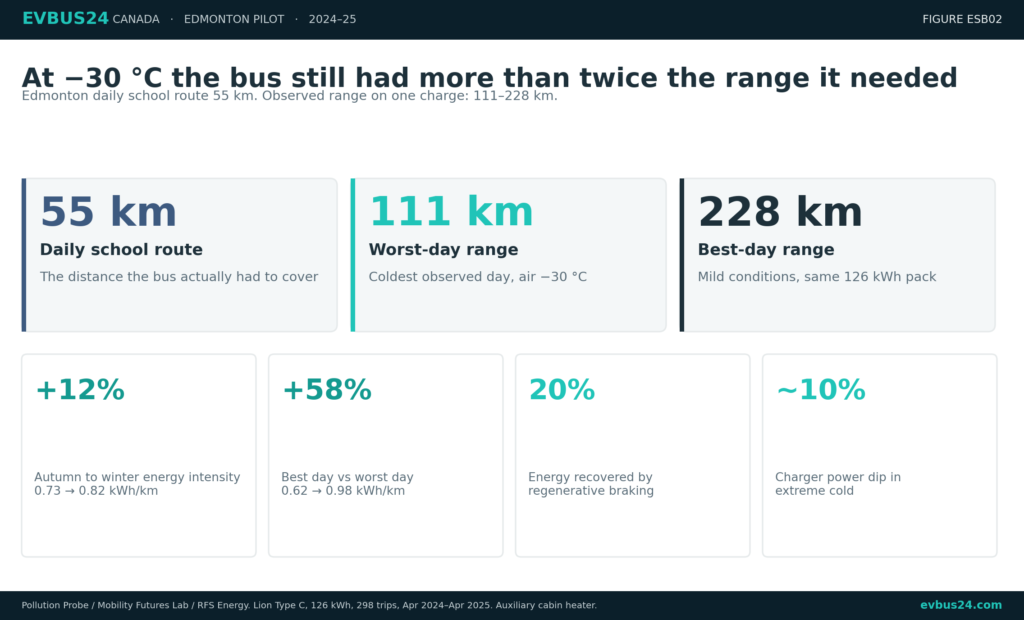
Converted into range, the Edmonton bus delivered between 111 and 228 kilometres on a charge. The daily school route was about 55 kilometres (32 miles). Even on the coldest day the vehicle kept more than double the distance it needed. Rental Bus Lines called it the most reliable bus in the fleet. It was off the road for five weeks in a year: three after a charger wiring fault the operator repaired itself, and two after the bus was struck by lightning. Neither event is a winter-chemistry failure.
A predecessor trial in Calgary, from September 2022 to June 2023, used a Blue Bird electric school bus with a 155-kilowatt-hour pack and electric cabin heat, without the auxiliary diesel heater. Energy intensity rose more sharply in the cold, as expected when the battery is asked to heat the cabin as well as move the vehicle. Pollution Probe’s public finding was still that the bus could deliver up to 213 kilometres depending on conditions, and that operators who pre-heat while plugged in and plan a midday charge on the longest routes can keep the duty. Cedric Smith, director of transportation at Pollution Probe, summarised the Edmonton follow-up in September 2025: winter operations “can be viable, especially with an auxiliary diesel heater,” which he described as an interim measure on the way to fully electric heating.
The same pattern appears south of the border. Three Rivers Community Schools, outside Kalamazoo, Michigan, put two Lion Type C buses into service in January 2020. Winters there reach -20 °F. Kenni Jean Schrader, the transportation supervisor, has said repeatedly that the buses “have driven exceptionally and, in fact, often outperform their diesel counterparts in cold weather.” The extra mass of the pack, placed between the axles rather than over the front axle, made the vehicles less likely to fishtail on snow. They started more reliably on cold mornings and reached a comfortable cabin temperature faster. Small five-gallon auxiliary heaters burned about 52 gallons of diesel in the coldest month and sat unused for most of the year – a fraction of what a diesel school bus consumes as traction fuel at roughly six miles per gallon.
Michigan’s Department of Environment, Great Lakes, and Energy surveyed the first seven districts that received the state’s 2019 Fuel Transformation grants. Four of the seven reported no cold-weather problems at all. The others noted some reduction in battery performance but no interruption of service. One district said the electric buses started more quickly and smoothly than diesels below freezing.
West Grand School District in Kremmling, Colorado, runs a Blue Bird Type D on routes that climb above 9,000 feet, with morning temperatures between −33 and −18 °F. Cabin heat stayed “responsive, reliable, and comfortable.” The district keeps the bus in a heated garage so the pack is not asked to wake from a deep freeze. It liked the result enough to order two more buses through the federal Clean School Bus programme for 2025.
Garretson School District in South Dakota reported three electric buses running in below-zero weather. Their longest route is 47 miles; the buses are quoted at up to 125 miles in mild conditions. The winter did not threaten the school run. Williamsfield, Illinois, told a rural-district panel that its electric buses outperformed neighbouring diesels in winter months and, with rooftop solar at the depot, was seeing an 86 percent fuel-cost saving.
Pellston Public Schools, a 461-student rural district in northern Michigan with a high share of Indigenous pupils, is the case that most cleanly answers the “but we have real winters” objection. Superintendent Stephen Seelye took federal Clean School Bus money for four buses quoted at a 120-mile range, nearly three times the district’s routes. After a difficult winter and a manufacturer bankruptcy that forced a later switch of supplier, he still said in 2026: “It’s been a very difficult winter, but the buses have done well.” Earlier he had put the annual fuel-and-maintenance saving at around $50,000. “That’s close to the cost of a teacher.” Drivers, he added, “rave that their new vehicles handle the wintry roads far better, and they appreciate how the buses can be programmed to preheat ahead of time.”
The operational recipe is not exotic. Pre-condition the cabin and the pack while the bus is still plugged in, so the morning departure does not spend the first ten kilometres making heat. Specify an auxiliary cabin heater if the district sits in a true cold climate and wants to keep the traction battery for traction. Use the midday dwell. Do not assign the first electric bus to the single longest Friday athletics trip. Those are fleet-management decisions. They are not evidence that the chemistry fails.
United States: what school officials say after the electric school buses arrive
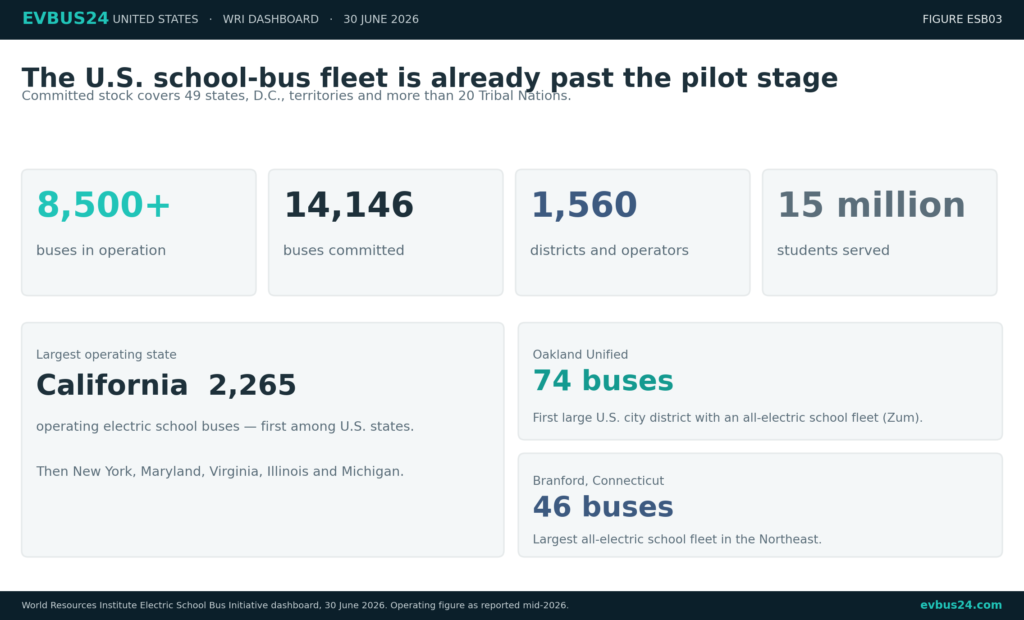
By 30 June 2026 the World Resources Institute dashboard counted 14,146 electric school buses committed across 49 states, Washington, D.C., the territories and more than 20 Tribal Nations. More than 8,500 were already in operation. They sat in 1,560 districts serving more than 15 million students. California led with 2,265 operating buses, followed by New York, Maryland, Virginia, Illinois and Michigan. Oakland Unified School District became the first large city district with an entirely electric school-bus fleet, 74 vehicles, under a contract with Zum. Branford Public Schools in Connecticut ran 46, the largest all-electric school fleet in the Northeast.
The federal Clean School Bus Program, which made nearly five billion dollars available through the Environmental Protection Agency, is the reason the American numbers moved from dozens to thousands. What the grants cannot do is invent a quote from a transportation director. Those have to come from the yard.
Electric school buses can support local grid
Shawnee Public Schools in Oklahoma ran eight electric buses, half the fleet, in 2024–25 and saved $40,900 on fuel alone. After a 2023 tornado destroyed much of the town’s electrical infrastructure and left the community without power for ten days. The district began treating the buses as mobile batteries. In July 2026, during a record heat wave, transportation director John Wiles sat at his desk and discharged more than 800 kilowatt-hours from four buses back to the Oklahoma Gas & Electric grid over four hours. “I think in the long run, it’s going to be so beneficial to Shawnee Public Schools that it’s worth it to me,” Wiles said. “We saved so much money just running the electric bus. Now that we’re going to the V2X, we’re going to save even more money.”
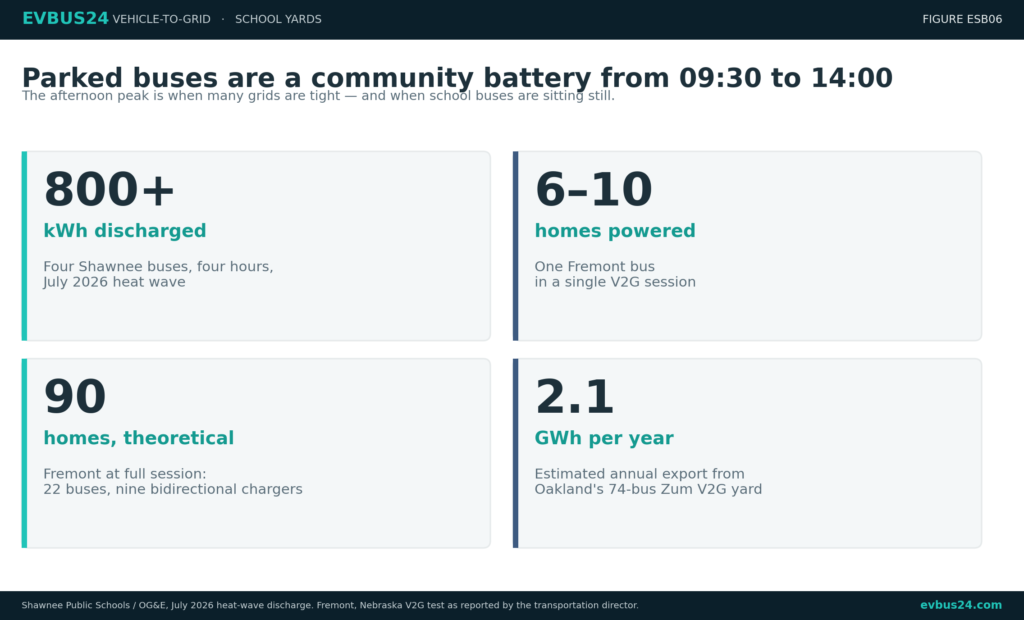
Fremont, Nebraska, tested vehicle-to-grid discharge. Ernest Epley, director of transportation, said one session from one bus generated enough energy to power six to ten homes. With 22 electric buses and nine bidirectional chargers, the theoretical session was 90 homes. That is not a school-transport requirement. It is a community asset that happens to live in the bus yard from 09:30 to 14:00.
The quieter cabins had a second effect. Assigned to routes with higher rates of behavioural incidents, the electric buses coincided with a drop of nearly 50 percent in reported incidents between 2022–23 and 2024–25. Drivers noticed that students with sensory sensitivities were more willing to ride.
Savings with BEV school buses
Mondovi, Wisconsin: superintendent Jeff Rykal estimated about $14,000 a year in fuel savings on five buses. Pine-Richland, Pennsylvania: electric buses and other electric vehicles covered nearly 43,000 miles in 2024–25 and saved more than $21,000 in fuel, with officials expecting the figure to double. Orangeburg County School District in South Carolina took 20 buses through an EPA grant. Superintendent Dr Shawn D. Foster said: “With our students traveling 1.3 million miles annually, these buses ensure a safer, cleaner journey, reducing harmful emissions and aligning with our commitment to a healthy learning environment.”
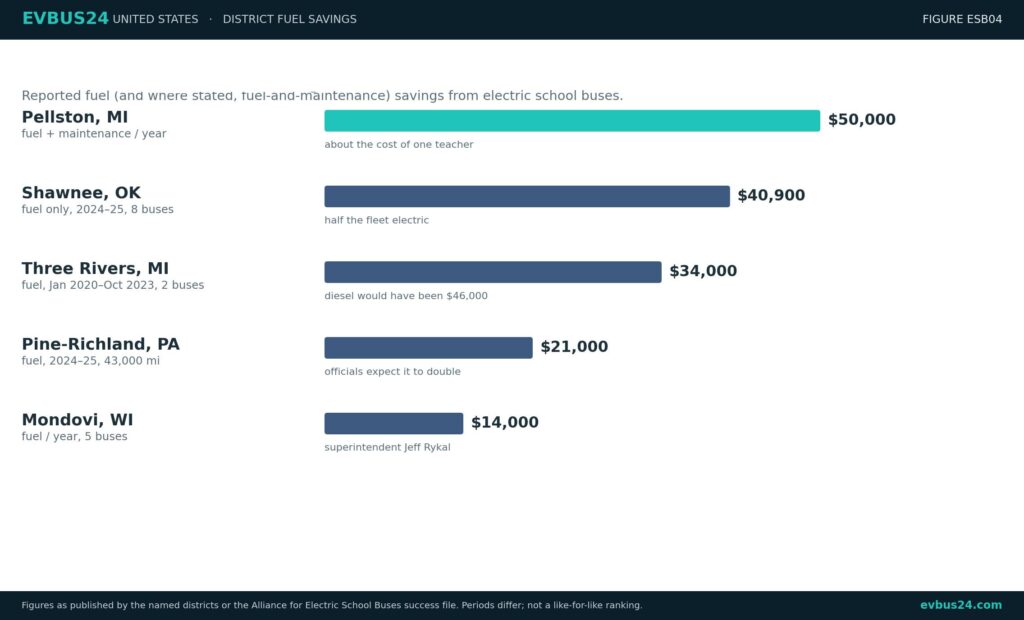
Let’s come back to Three Rivers again, because there’s another example of money saving. Brian Leonard, director of facilities and operations, reported that two Lion buses saved $34,000 in fuel between January 2020 and October 2023. Charging those miles cost $12,034; the diesel equivalent would have been about $46,000. Schrader told a later interviewer that the end of the fuel and repair saving “we are able to see that money go back into the classroom of the students.” The Alliance for Electric School Buses has collected similar lines from Kentucky, Missouri and Texas districts: one said the saving funded a district-wide teacher pay increase; another compared it to “the cost of four beginning teachers with benefits.”
Canada: the cold-climate laboratory
Canada is useful because it removes the last climatic excuse. If a Lion Type C can double its route length at -30 °C in Edmonton, the argument that “our winter is different” needs a number, not a feeling.
The Edmonton and Calgary demonstrations are the best-documented public datasets. They publish energy intensity by season, regenerative-braking recovery, charger behaviour and off-road days. The headline – more than twice the required range on the worst day – is the one that should be taped to the wall of any school-board meeting that starts with “but the batteries will die.”
A separate operational voice comes from northern service, where school cancellation thresholds sit at -40 °C. Operators who have run electric school buses in that band describe a reversal of the usual winter scene. Diesel buses are the ones that struggle to crank. An electric bus with a thermally managed pack and a programmed pre-heat arrives with a clear windscreen and a warm cabin, because the heater can run off the plug before the driver sits down. One northern operator told Green Energy Futures that range “hasn’t been an issue at all” on a bus rated at 150-175 kilometres, covering about 90 percent of current routes, with a three-hour charge on an 80-amp unit after a normal day that uses only half the pack.
There is an irony here that diesel loyalists rarely enjoy. In the Yukon and other far-northern systems, diesel school-bus cancellations in deep cold are a recurring news item: diesel exhaust fluid freezes below -11 °C if the engine is not kept warm; winter fuel begins to fail below -40 °C. Electric drivetrains do not use diesel exhaust fluid. They do need a thermal strategy. That is a solvable engineering task. Frozen DEF on a diesel bus is a chemistry task that reappears every January.
Canadian total-cost numbers depend on the incentive stack, as they do everywhere. Pollution Probe’s Calgary business case found that, in Alberta, an electric school bus had a 21% cheaper total cost of ownership than diesel with federal incentives, and a 19% higher cost without them. That is an honest sentence. Grants change the arithmetic in year one. Energy and maintenance change it in years two to twelve. Districts that only look at the sticker price are answering the wrong question.
Electric school buses in Poland: the electric “gimbus” in small communes
“Gimbus” is just a coloquial terms for a school bus, it dervies from a few years back when Poland introduced the transformatin of educational system and added a secondary school which was called “gimnazjum”. Therefore, naturally, a bus that took children to school became “gimbus”. Gimanazjum no longer exists, but the term “gimbus” remained for a school bus.
Poland’s electric-bus story is usually told as a city story: Solaris in Warsaw, Poznań and Gdańsk; Yutong in Białystok; Irizar in the Górnośląsko-Zagłębiowska Metropolis. The school-transport chapter is quieter and, for a parent, more interesting. It happens in communes of a few thousand people.
The first electric school bus built by Solaris for pupil work went to Gmina Godzianów, near Łódź, in 2020, under the National Fund for Environmental Protection and Water Management programme “Kangur – a safe and environmentally friendly way to school.” The vehicle was an Urbino 12 electric in school orange, 41 seated children, a belt on every seat, and a High Energy+ pack of almost 240 kilowatt-hours. Solaris stated a range of at least 200 kilometres “in all road and weather conditions.” That is four to six times a typical rural school loop in a Polish commune.
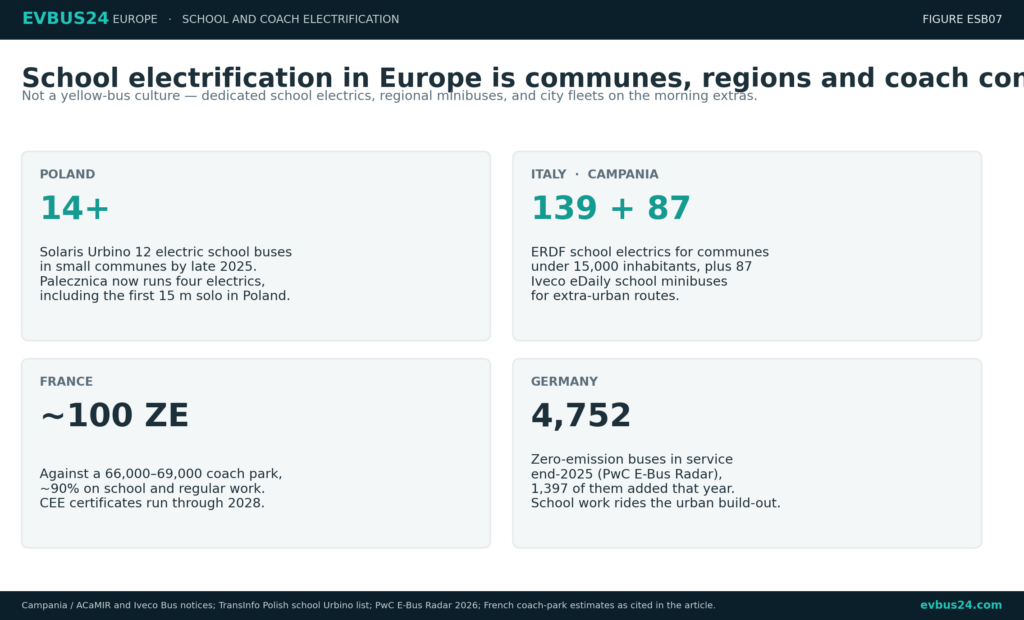
By late 2025 the running list of Solaris Urbino 12 electric school buses in Polish communes included Godzianów, Gręboszów, Bielany, Pałecznica, Działoszyce, Troszyn, Krasnopol, Przedecz, Skalbmierz, Rusinów, Rzeczyca, Grabów nad Pilicą and Śniadowo – fourteen vehicles, with Pałecznica taking a second, “towerless” Urbino 12 electric whose modular High Energy pack of 260 kilowatt-hours, expandable to 350, sits on the roof rather than in a rear battery tower. That bus won the TransInfo readers’ Polski Bus 2024 award in the intercity category. The commune paid PLN 2,799,999.06 gross, co-financed by the Polski Ład strategic investment programme. It already ran an earlier Urbino 12 electric from the Kangur scheme and a Mercedes-based Mercus electric minibus.
In February 2026 Pałecznica went further and took the first series-delivered 15-metre electric solo bus in Poland, a Solaris Urbino 15 LE electric, 59 forward-facing seats, three-point belts, a stated range of at least 250 kilometres, and a mobile plug-in charger. The municipal office put it plainly: “A new bus has arrived in the Pałecznica Commune. It’s worth noting that it’s the longest electric solo bus in Poland. The bus seats 59 and will serve our residents, providing comfortable and eco-friendly travel.” A rural commune of about 3,700 people now runs four electric pupil vehicles. That is not a capital-city showcase. It is a local-government procurement choice, repeated.
Gmina Budzyń put a Solaris Urbino 12 electric on the road on 12 May 2025 for the school run to Wyszyny and for excursions. The municipal notice stated a range of about 300 kilometres on one charge, “which fully covers the needs of local routes.” Gross cost for the bus and an 80-kilowatt charger was PLN 3,153,695.40, of which PLN 2,000,000 came from the eighth edition of Polski Ład. The council increased the local contribution when the sole bid came in above the original ceiling. The vehicle replaced a worn diesel. The commune’s own text called it “an expression of concern for the environment and the comfort of residents.”
Grabów nad Pilicą took a green-liveried Urbino 12 electric in August 2023 — green rather than school orange, matching the commune colours and the zero-emission claim. Mayor Euzebiusz Strzelczyk collected it with the deputy mayor, the secretary and the school director. The commune wrote: “The purchase of an electric bus was one of the most important projects undertaken in our municipality. We deeply believe that this vehicle will serve us all for many years to come, and that using it instead of a combustion engine will positively impact the quality of the air we breathe..”
These are not urban rapid-transit statistics. They are the European counterpart of Pellston and Mondovi: small authorities, one or two vehicles, a charger in the yard, a route that a 200-kilometre pack can cover in any Polish winter. The funding stack – Kangur, Polski Ład, later KPO urban programmes for the city fleets – is what made the capital cost tolerable. The operating experience is what keeps the second and third buses coming.
City electric buses in Poland supply a supporting observation for school work. MZK Biała Podlaska put twelve Solaris Urbino 12 electrics, with the manufacturer’s largest packs, onto urban routes and reported that a bus finishing a 300-kilometre duty still held 37 percent state of charge — “which means the ability to work without top-ups even in winter conditions.” School routes are shorter than that urban example. The pack is not the binding constraint.
Electric school buses in Italy, France and the rest of Europe
Europe does not have a single yellow-bus culture. Pupil transport is a mix of dedicated school vehicles, municipal city buses on school-timed extras, and coaches on morning and afternoon contracts. Electrification therefore arrives by several ways.
Italy is moving the dedicated school fleet at regional scale. Campania, using the 2021–27 ERDF programme, allocated €39 million for 139 ecological school buses for municipalities under 15,000 inhabitants, to carry primary and lower-secondary pupils.
The first vehicles presented were 7.6-metre electrics with an electro-hydraulic rear lift and a wheelchair bay: 29 pupil seats, or 24 with a wheelchair on board. ACaMIR, the regional mobility agency, signed the programme contract with Iveco and the beneficiary communes. A follow-on tender awarded Iveco Bus 87 eDaily electric school minibuses, under eight metres, for extra-urban and interurban routes across all five provinces, with particular attention to inland and smaller municipalities. USB ports, air-conditioning, destination displays, a lift, ADAS, cameras, GPS to an operations centre and an emergency alert system are specified as school equipment, not as urban-bus extras.
Iveco has described itself as the only manufacturer offering a 100 percent electric minibus designed for school transport and built in Italy. Campania is, on current evidence, the first Italian region to put a fully electric school-transport programme on the road at this scale.
France’s school-and-coach park is the largest conversion opportunity on the continent: on the order of 66,000–69,000 coaches, roughly 90 percent of them on school and regular work, and only about 100 zero-emission coaches in service as recently as 2023. The CEE energy-saving certificate framework, extended through 31 December 2028, covers purchase, lease and retrofit of electric coaches and buses. Rouen’s documented retrofit programme of 49 vehicles and a Transdev order of 20 sit inside that frame. Transdev’s renewed nine-year Astuce contract for Métropole Rouen Normandie, running 2026–2034, folds school lines into a network that already had 91 battery-electric and 14 hydrogen buses by 2025, against two electric buses in 2020, with a target of a fully decarbonised bus park by 2032. That is not a dedicated “yellow bus” story. It is the European pattern: the same depot, the same chargers, the morning school extras and the all-day city routes sharing a fleet.
Germany’s contribution is industrial depth rather than a single school-bus brand. PwC’s E-Bus Radar put 4,752 zero-emission buses in German service at the end of 2025, 1,397 of them added in that year. Mercedes-Benz eIntouro and MAN’s electric coach products are the school-and-shuttle vehicles sitting on the back of that urban build-out. Charging workshops, high-voltage technicians and depot electricians trained on city buses are the same people a county will call when it electrifies a school commute.
The Netherlands, Belgium and Luxembourg already run some of the highest zero-emission shares of new city buses in Europe. Dutch city-bus sales have been effectively all zero-emission for several years. School-timed lines in those networks electrify as a by-product of the urban rule, not as a separate moral campaign. Nordic city systems – Oslo, Trondheim, Stockholm, Malmö, Piteå, Ystad – have spent a decade learning depot charging in real winters. Lund University’s e(+)bus project, reporting in 2025 on six Swedish cities plus Oslo, Trondheim and Eindhoven, is a governance study rather than a school-bus study, but its operational lesson travels: own the chargers and the depot strategy, write contracts that allow technology to move during the term, and treat winter as a planned energy-intensity increase rather than a surprise.
The United Kingdom’s school-transport electrification is still thinner than its city-bus conversion. England has a school charging-grant programme that has put thousands of sockets into the ground; London’s contracted bus fleet was 32.9 percent zero-emission at 31 March 2026, with 2,957 battery and hydrogen vehicles. Dedicated school-coach fleets remain the slower half of that story. The infrastructure being built for local bus service is the infrastructure school contracts will use.
The advantages of electric school buses that actually show up in the yard
First of all, let’s discuss the environemnt and children’s health. A diesel school bus emits nitrogen oxides and fine particles at the curb, next to children who have smaller airways than adults and who sit on the vehicle twice a day. Electric propulsion removes the tailpipe. Life-cycle carbon then depends on the grid. In Alberta, Pollution Probe estimated 28–38 percent less greenhouse gas per year than diesel on the current mix, and 40–49 percent less NOx, with the higher figure attached to electric rather than diesel-fired cabin heat. In a coal-heavy energy mix the carbon saving is smaller; on a hydro or wind energy mix it is larger. The local air-quality saving is available on day one, at the school door.
The health case is the one paediatricians care about. Diesel exhaust is a classified carcinogen. Children on diesel buses breathe a higher concentration of particulate matter than children who walk, in part because the engine sits in the same moving box. Quieter cabins are not a luxury detail. Shawnee’s drop in behavioural incidents, and the return of pupils with sensory sensitivities, is the sort of finding a board can measure without a spectrometer.
Secondly, cost play important role here as well. Electricity per kilometre is cheaper than diesel per kilometre in every jurisdiction covered in this briefing. Maintenance is cheaper because an electric drivetrain has a fraction of the moving parts of a diesel: no oil changes at the same cadence, no diesel particulate filter, no exhaust fluid, no transmission in the same sense. Three Rivers cut fuel cost by about 75 percent on the electric pair. Shawnee saved $40,900 in a year on eight buses. Mondovi’s superintendent put a single-district fuel saving at $14,000. Pellston’s superintendent compared the combined saving to a teacher’s salary. Kentucky, Missouri and Texas districts in the Clean School Bus success file said the same thing in their own words: the savings are real.
What is more, the comfort of bus drivers also plays a role here. Electric buses start in the cold. They pre-heat on a timer. They do not fill the cab with fumes at the first stop. They are heavier and lower, which helps on snow. Three Rivers, Pellston, Williamsfield and the Edmonton operator all reported that drivers preferred the electric vehicle once they had lived with it. That preference is an operating fact.
Last but not least, the community-energy benefit is optional, however increasingly real. School buses are parked in a dense pack during the afternoon peak, which is when many electricity systems are tight. Bidirectional chargers let a district sell a slice of the pack back to the utility and still leave enough energy for the afternoon run after a top-up, or hold the pack as a shelter and a generator after a storm. El Cajon in California, Durango in Colorado, West Linn in Oregon, Oakland’s Zum yard, Shawnee and Fremont have all run versions of this. Compensation in El Cajon has been reported at $2 per kilowatt-hour for dispatched energy. Oakland’s 74-bus V2G yard has been estimated at 2.1 gigawatt-hours a year back to the grid. A school board does not have to become a power trader. It should know the option exists.
What still goes wrong, so that the rest can be trusted
A briefing that only recites successes is not useful to a transportation director. Three things have gone wrong in the first decade, and they should be named.
The first is manufacturer support. Several North American districts that bought early Lion Electric buses later found themselves with vehicles they could not get repaired after the company entered bankruptcy and restructuring. Vermont’s Champlain Valley discussion in 2026, after a depot fire, and reports from Winthrop in Maine and Herscher in Illinois, are warnings about warranty continuity, not about batteries as a class. Pellston’s response was to change supplier on the next grant round. Procurement documents should require parts availability and a named service partner that survives the OEM.
The second is charger installation, not the bus. Districts that treat the vehicle as the project and the plug as an afterthought wait six months for a transformer upgrade and then blame the technology. Steelton-Highspire in Pennsylvania and Westville in Illinois used an above-ground charging platform to avoid trenching delays. Level 2 overnight charging is enough for most school routes; the Edmonton trial said so explicitly. Fast chargers are for the long Friday trip and the depot that shares power with a city fleet.
The third is route assignment in week one. An electric school bus put on the single longest, hilliest, coldest contract on the first Monday will be asked to prove a point it does not need to prove. Start with the median route. Collect a term of telematics. Then stretch. Every successful district in this summary did some version of that, even when, like Three Rivers and Salt Lake City, they later put electrics on the long runs on purpose.
Those are management failures and counterparty failures. They are not evidence that a 200-kilometre pack cannot cover a 50-kilometre school day in January.
How a district or a commune actually does this
Let’s divide the process in a few steps.
- Map the routes. Write down morning kilometres, afternoon kilometres, the longest Friday variant, and the coldest week of the last five years. Apply a 20 to 30 percent energy margin for heat and hills. If the resulting number is under the usable pack of the bus on offer, the route is eligible. Most of them will be.
- Order the charger with the bus, not after it. A 19-kilowatt unit per vehicle, on a tariff that is cheap at night, is the default. Bidirectional chargers are a second-wave decision once the district has a utility that will pay for discharge.
- Train the drivers on regenerative braking and pre-conditioning. The Edmonton 20 percent recovery figure is free range. A driver who leaves the bus unplugged on a -20 °C night is the diesel equivalent of leaving the block heater unplugged. The habit is the same. Only the socket changes.
- Keep a diesel or a larger-pack electric for the rare 200-kilometre sports trip until the fleet is deep enough to cover it. Do not let that rare trip veto the 180 ordinary days.
- Put the fuel-and-maintenance saving in the board minutes as a classroom line, the way Three Rivers, Shawnee, Mondovi and Pellston did.
- use the financial instruments that already exist. Polish communes have Kangur and Polski Ład behind them and a domestic builder that already makes the school variant. Italian municipalities under 15,000 inhabitants in Campania have a regional ERDF envelope and a signed Iveco contract. French autorités organisatrices have the CEE certificates through 2028 and a retrofit market that was designed for the coach park. Dutch and Nordic operators have city-bus depots that can take school extras without a new religion.
Summary of BEV school buses
Electric school buses are no longer a demonstration. They are a production vehicle on two continents, in deserts, in mountain districts above 9,000 feet, in Michigan lake-effect snow, in Alberta at -30 °C, and in Polish villages that most capital-city reporters will never visit.
Range, on the published route data, is not scarce. The average North American school run is about 50 kilometres a day in two pieces. Current packs deliver two to six times that, even after a winter reduction. Edmonton’s worst day still left a double margin. Biała Podlaska’s urban electric finished 300 kilometres with more than a third of the pack remaining. Pałecznica specified 250 kilometres for a 15-metre school bus in a commune of 3,700 people.
With a proper heating strategy the BEV school buses work great in winters too. Pre-conditioning on plug, thermal management of the pack, and a midday top-up on the long routes are the whole list. Districts that used that list – Three Rivers, West Grand, Garretson, Pellston, Edmonton, Calgary – kept the timetable. Drivers in those places describe better footing on snow and a cabin that is warm when they sit down. Diesel buses in the same climates still fail to crank and still cancel when the exhaust fluid freezes.
What school officials say, once the novelty has worn off, is not poetry. They talk about $14,000, $21,000, $40,900, $50,000, a teacher, four beginning teachers, a 50 percent drop in incidents on the quiet routes, children with sensory sensitivities who will ride again, and a bus that is the most reliable vehicle in the yard. Jeff Rykal, John Wiles, Kenni Jean Schrader, Brian Leonard, Stephen Seelye, Lee Minzey, Ernest Epley, Dr Shawn D. Foster, Katie Tiger, Euzebiusz Strzelczyk and the municipal office in Pałecznica are not a marketing department. They are the people who have to put a vehicle on a road at 06:40 in January.
The remaining work is procurement discipline, charger lead times and service contracts that outlive a single manufacturer.
Sources: World Resources Institute Electric School Bus Initiative and dashboard (commitments and operating stock to 30 June 2026); U.S. Department of Energy / NREL route and charging analyses; Alliance for Electric School Buses success file and district quotations; Michigan EGLE Fuel Transformation survey; Pollution Probe Edmonton (April 2024–April 2025) and Calgary (2022–23) demonstrations; CALSTART cold-weather case studies; TransInfo and municipal notices for Polish school Urbino deliveries (Godzianów, Pałecznica, Budzyń, Grabów nad Pilicą); Campania Region / ACaMIR and Iveco Bus notices for the 139-bus and 87-bus school programmes; PwC E-Bus Radar 2026; Lund University e(+)bus (2025); TfL fleet audit 31 March 2026; Métropole Rouen Normandie / Transdev Astuce contract notices. Figures are those published by the cited organisations at the dates given in the text.