UNCATEGORIZED · 20 Nov 2026
Innovation in electrical buses
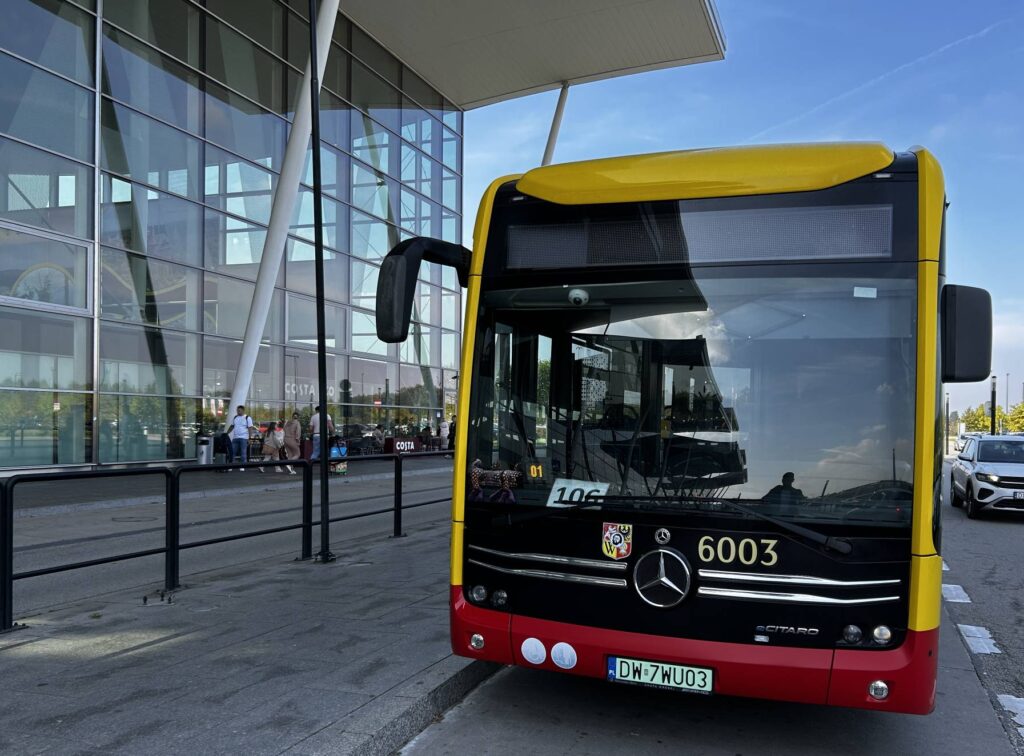
Electric bus manufacturers research their own innovation schemes. Many developments go together with the overal EV progress. The goal for most projects is to lower energy consumption and extended the range. In this post we look at where the kilowatt-hours go on a city bus and what manufacturers do to reduce them.
We cover wheel-arch fairings on the Heuliez buses in Nice, aerodynamics, drivelines, batteries and thermal management. At the end you will find a list of items you can put into a procurement specification.
Wheel-arch fairings
During my trip to Nice, France I spotted that Heuliez electric buses on the Lignes d’Azur used wheel-arches.
The French purchasing body CATP writes it into the GX 337 Elec sheet as “wheel covers on all wheels”, paired with the BHNS tram-style front.
Transbus and the Heuliez catalogue call the same parts wheel fairings. They are available on the whole GX range and look standard on the Linium front used for high-level bus corridors.
The Nice fleet
Nice runs the 12m GX 337 E. Since summer 2023 it has also run GX 437 E artics on line 12 with OppCharge.
A further 29 artics went onto lines 8+ and 12+ at the end of October 2024. The city describes that BHNS as:
-
29 battery-electric artics
-
up to about 150 passengers
-
eight-minute peak headway
Typical kWh/km of a 12m electric city bus
Wheel covers are one small piece of a wider effort to reduce kilowatt-hours per kilometre.
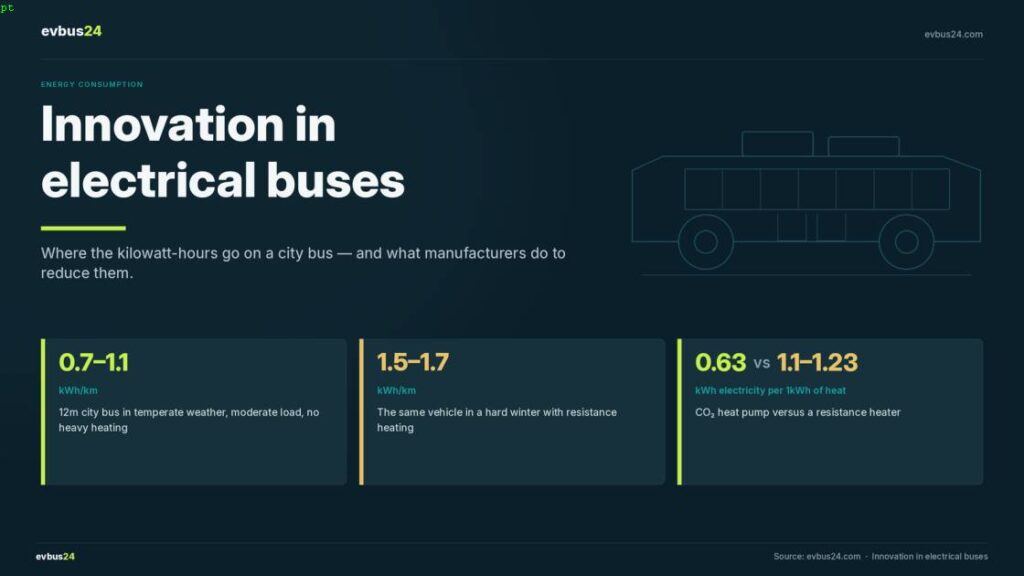
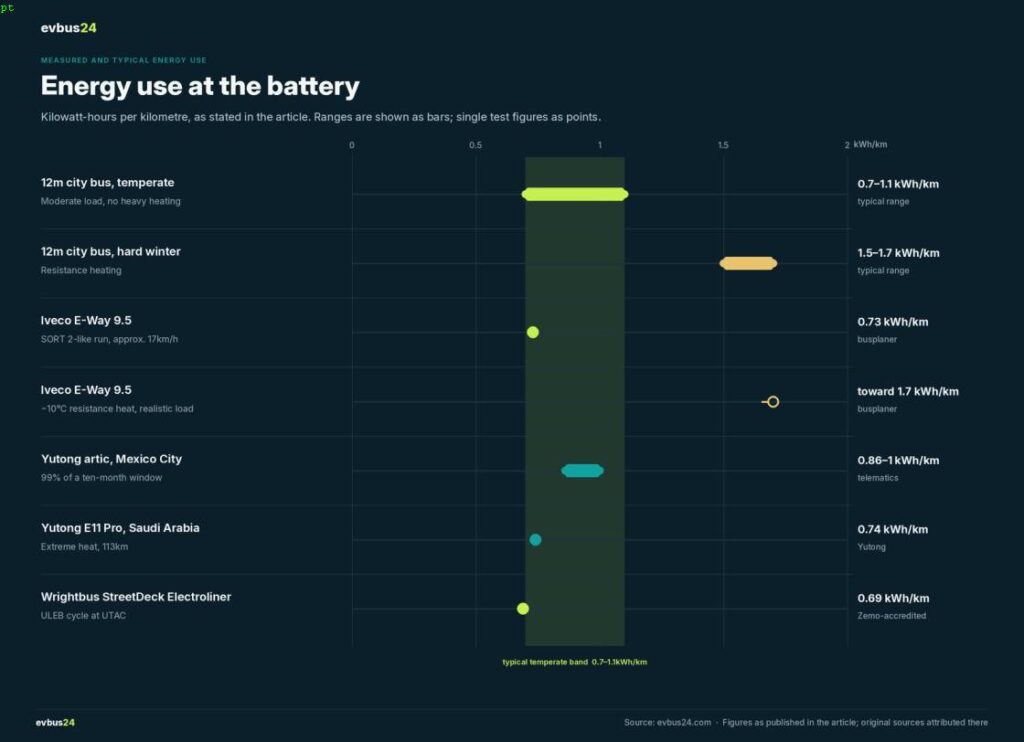
A 12m electric city bus in temperate weather, moderate load and without heavy heating typically sits between about 0.7 and 1.1kWh/km at the battery. The same vehicle in a hard winter with resistance heating can clear 1.5-1.7kWh/km.
busplaner measured an Iveco E-Way 9.5 at 0.73kWh/km over a SORT 2-like run at about 17km/h. It then noted that a resistance heater at −10°C can itself draw up to 1kW per kilometre. With a realistic passenger load, this pushes the same configuration toward 1.7kWh/km.
Mexico City telematics on a Yutong artic sat between 0.86 and 1.0kWh/km for 99% of a ten-month window. Regenerative braking returned 21-24% of energy, about 130kWh a day.
Drivetrain efficiency now differs by a few percent between designs. Climate control, mass, charge strategy and, on faster corridors, air move the operating number by tens of percent.
|
Vehicle / condition |
Consumption |
Source |
|
12m city bus, temperate, moderate load, no heavy heating |
approx. 0.7-1.1kWh/km |
typical range |
|
12m city bus, hard winter, resistance heating |
1.5-1.7kWh/km |
typical range |
|
Iveco E-Way 9.5, SORT 2-like run, approx. 17km/h |
0.73kWh/km |
busplaner |
|
Iveco E-Way 9.5, −10°C resistance heat, realistic load |
toward 1.7kWh/km |
busplaner |
|
Yutong artic, Mexico City, 99% of ten months |
0.86-1.0kWh/km |
telematics |
|
Yutong E11 Pro, extreme heat, Saudi Arabia, 113km |
0.74kWh/km |
Yutong |
|
Wrightbus StreetDeck Electroliner, ULEB cycle at UTAC |
0.69kWh/km |
Where the kilowatt-hours go
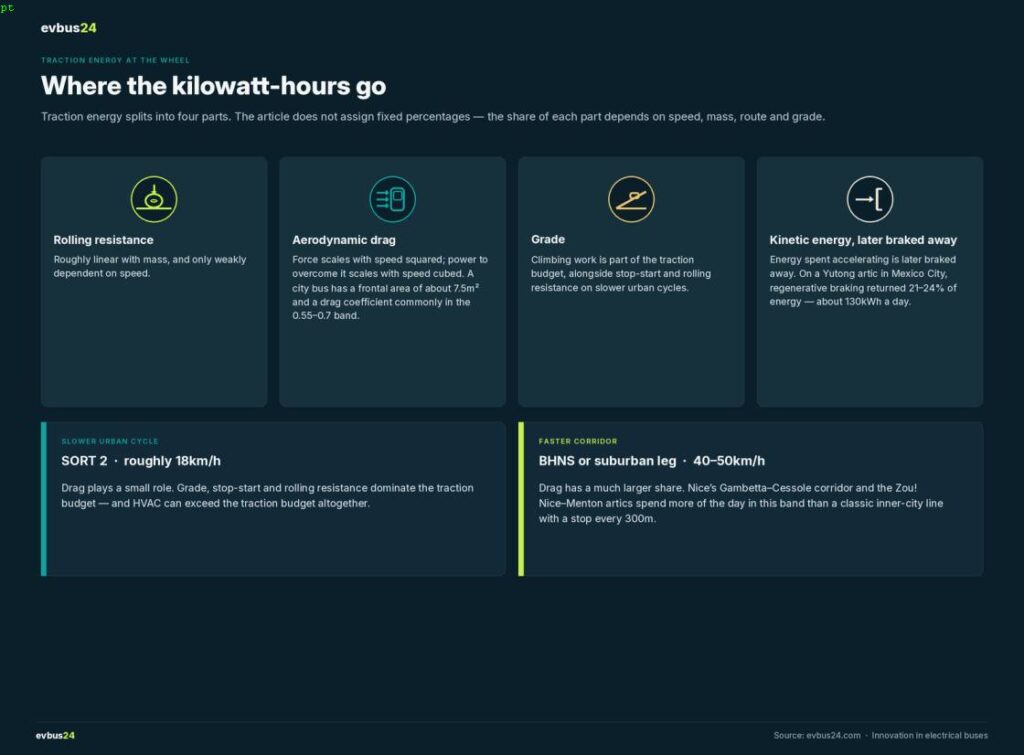
Traction energy at the wheel splits into four parts:
-
rolling resistance
-
aerodynamic drag
-
grade
-
kinetic energy that is later braked away
Rolling resistance is roughly linear with mass and only weakly dependent on speed.
Drag force scales with speed squared and with frontal area times drag coefficient. The power to overcome it scales with speed cubed.
Drag coefficient of a city bus
A city bus has a frontal area of about 7.5m² and a drag coefficient commonly in the 0.55-0.7 band in published CFD.
A scaled electric-bus study on SSRN started from a Cd of 0.603. After roof, ground-clearance and windscreen changes, it reported a combined Cd cut of about 22%.
That study is a 1:10 CFD exercise and the model is not a homologated bus. The order of magnitude matches what body engineers quote.
Drag at SORT speed and on a BHNS corridor
At a SORT 2 average of roughly 18km/h, drag plays a small role. Grade, stop-start and rolling resistance dominate the traction budget, and HVAC can exceed the traction budget altogether.
On a BHNS or a suburban leg at 40-50km/h, drag has a much larger share.
Nice’s Gambetta–Cessole corridor and the Zou! Nice–Menton artics spend more of the day in that band than a classic inner-city line with a stop every 300m. For this reason a wheel-arch shield is worth specifying on a BHNS bus, and looks optional on a slow urban spec.
Research on wheel housings
An ARAI Academy paper (SAE 2019-28-2394) ran ANSYS Fluent on an electric-bus body with wheel housings at the front only, the rear only, and both. It reported a clear drop in Cd and in calculated energy use versus open arches.
The paper does not publish a single fleet number operators can drop into a tender. What is more, brake cooling and stone damage still constrain how closed the arch can be.
Heuliez’s solution is the conservative one: a fixed polyester or composite fairing around the arch. It does not use an active shutter.
Yutong’s Chinese utility patent CN207683623U addresses a different problem on the same geometry. It specifies a double rigid wheel cover with a closed hollow cavity, aimed at noise from in-wheel motors and at stone and mud protection. The cavity also adds stiffness if a tyre fails.
In simple words, the two manufacturers are solving adjacent constraints on the same dirty, turbulent volume of air.
Aerodynamic features on production city buses
Production city buses cannot take a teardrop tail or a full undertray. Doors, kneeling, a 320mm entrance height and a turning radius near 9m on the GX 337 fix the package.
Below we list the aerodynamic features that do reach production.
Wheel-arch fairings and wheel discs
Heuliez offers both carénages and enjoliveurs. The fairing closes the cavity that otherwise sheds a turbulent wake at each corner. Discs cut the pumping loss of an open wheel.
Brake heat is the limit. A city bus brakes hard and often.
A fully sealed disc that works on a coach at steady speed can overheat linings on a 12% grade with a full standee load.
Front and roof
The Linium nose on the Heuliez is a rounded BHNS face. The standard city face is flat.
Roof battery packs and HVAC pods are the other large bluff body. RATP GX 337 E vehicles have carried a revised roof fairing over the packs.
A clean roof costs less in drag than an open rack of modules. It also keeps stone chips and standing water off high-voltage boxes.
Glazing and side skin
VDL’s current Citea uses a one-piece composite sidewall, stated as 15% lighter than a conventional side panel, with the cold bridges removed.
Double glazing is standard on that generation. VDL says it cut energy use by 10% through lower thermal loss. It quotes an overall consumption reduction of about 25% once driveline, climate software, aero and mass are counted together.
In November 2023 a 12m Citea LF-122 with a 490kWh floor pack, ballasted to 16,500kg, covered 546.7km without an intermediate charge. It took 26 hours 14 minutes at 20.84km/h average and 1.4 stops per kilometre.
Mass reduction at Irizar
Irizar’s ie bus Efficient and ie tram Efficient, shown through 2026, take about 1,000kg out of the 12m and about 1,200kg out of the artic. Irizar states a consumption cut of up to 10% against the previous generation.
The levers Irizar names are:
-
a shorter structural parts list
-
a more compact motor
-
a new thermal manager
-
fourth-generation cells
The ie tram 12m can be specified to 714kWh in seven NMC modules of 102kWh, or about 483kWh in LFP.
Electric bus drivelines
Manufacturers have not converged on a single electric drivetrain. The efficiency gap between architectures is smaller than the maintenance and packaging gap.
Portal e-axle with two near-wheel motors
ZF’s AxTrax AVE (the old AVE 130) puts a liquid-cooled asynchronous motor at each wheel hub of a low-floor portal axle, 2×125kW. It is the volume choice on the Mercedes-Benz eCitaro and an option on the Solaris Urbino.
Solaris has said the e-axle path measured about 0.1-0.2kWh/km better than its central-motor alternative in internal comparison. Workshop access is harder.
ZF’s successor, AxTrax 2 LF, is quoted by the supplier as cutting average SORT energy by 20% against that previous axle. This would let an operator drop a battery module rather than add one. [internal link: electric bus motors]
Central motor
Solaris also offers a TSA asynchronous motor (160kW on the 12m) and ZF’s CeTrax.
The Urbino 15 LE electric was the first CeTrax application, 300kW, with silicon-carbide power devices that Solaris credited for lower consumption.
A central motor is quieter and easier to lift out. Some operators report better brake-energy recovery because the gearing and control loop are simpler to calibrate.
Volvo keeps a two-speed automated manual transmission behind its electric machine on the 7900 Electric. The purpose is to hold the motor nearer its efficient island across the urban and suburban speed range.
Wheel-hub motors at BYD
BYD’s European B12 and B13.b use two 150kW hairpin wheel-side motors. On the B12 the company calls them the first 900V hairpin wheel-side motors in the segment.
The B13.b press note pairs them with an integrated thermal loop covering:
-
drivetrain cooling
-
battery cooling
-
battery heat-pump heating
-
drivetrain waste-heat recovery
BYD states a 10% consumption cut on the test cycle versus the previous model.
The same family uses a 6-in-1 controller built on silicon carbide. It combines the drive inverter, steering-motor inverter, high-voltage distribution, compressor controller and DC-DC. It is claimed at 99.5% efficiency and 15% lighter than the previous controller set.
Yutong YEA platform
Yutong’s YEA platform, published for UITP, stacks the same ingredients with harder numbers:
-
multi-in-one SiC power-domain controller at up to 99.5% system efficiency, about 50% lighter, and about 5% lower vehicle consumption
-
integrated e-axle cutting powertrain mass by 49%
-
brake-energy recovery up to 77%
-
whole-vehicle consumption more than 15% lower
These are manufacturer figures from a product PDF. They do not come from an independent SORT sheet, and you should read them that way.
Heuliez traction packages
Heuliez took a third path and then simplified. Early GX 337 Elec vehicles used a BAE Systems traction package, the same family ADL used in Britain.
Later production moved to a Siemens ELFA machine, 160kW and 2,500Nm on the 12m. Outside France the bus is the Iveco E-Way.
In October 2019 a GX 337 ELEC ran 527km on the Iveco Magirus oval at Ulm at 46.6km/h average and stopped with 4% state of charge.
That is a track number in mild weather and differs from a Nice winter duty cycle. It is the cleanest public demonstration the factory has published of how far the high-energy pack can go when HVAC and grade are taken out of the problem.
Battery chemistry and energy consumption
Every extra kilogram of pack raises rolling resistance and the energy thrown away in braking.
Every chemistry choice changes how much of the nameplate energy is usable and how fast it can be taken back. It also changes how much auxiliary power the thermal loop consumes.
Heuliez: NMC and LTO
Heuliez still offers both ends.
High-energy NMC packs from Forsee Power, roof and rear, have been specified at 280, 315, 350 and 385kWh, later up to 460kWh on the GX 337 E. In the early sheets they were charged overnight by CCS at up to 100kW.
High-power LTO packs, 73 or 88kWh on the 12m and about 106kWh on the early artic, exist for pantograph opportunity charging.
LTO accepts very high C-rates and long cycle life at the price of low energy density. The bus carries less energy and charges often.
Nice’s line 12 artics and the Zou! Nice–Menton artics are in that family:
-
ABB inverted pantographs
-
300kW on the Zou! installation
-
a full charge quoted at under 15 minutes
-
three charge points on the Menton line, so the timetable does not grow a fuel stop
On the midi GX 137 E, busplaner noted passive air cooling of the Forsee packs and active balancing. It treated the absence of a liquid-cooling compressor as a real credit in the energy balance.
Mercedes-Benz: NMC3 and NMC4
Mercedes has stayed with NMC and pushed cell chemistry.
NMC3, built with Akasol, raised capacity about 50% at the same weight against the first eCitaro pack, with cells held near 25°C.
NMC4 enters the eCitaro, eCitaro G and eCitaro K from 2026. Daimler Trucks states nearly 6% higher energy density in the same installation space. Trade coverage of the Busworld pack quotes 111kWh against 98kWh for NMC3.
Packs remain interchangeable enough that a full-pack retrofit is described as conceivable. Charging is specified to 300kW. The solo and the short K variant go to six packs, 666kWh, with a stated range up to 600km.
BYD: cell-to-chassis LFP Blade
BYD’s European move is cell-to-chassis LFP Blade. Cells act as structural beams. The company states:
-
space utilisation about 50% better than a conventional pack
-
vehicle mass about 10% lower
-
centre of gravity down 30 to 40% depending on the model note
-
torsional stiffness above 55,000Nm/degree
The B13.b carries 476 or 560kWh, with provisional SORT ranges of 620 and 700km.
The Chinese e-Bus Platform 3.0, shown in September 2025 on the C11, moves to a 1,000V architecture with the same CTC layout. It adds a 7-in-1 thermal unit that BYD says cuts consumption by up to 18% and adds 50-80km in low-temperature running.
Volvo and Solaris
Volvo’s 7900 Electric offers flat NCA packs of 94kWh and about 600kg, or smaller LFP flat packs of 39 or 44kWh, in counts from three to twelve. The aluminium body structure is the mass offset.
Solaris High Energy+ modules with Impact Clean Power Technology moved from 88kWh to 102.9kWh in the same envelope, NMC. An operator can add energy without a new roof layout.
Thermal management and heat pumps in electric buses
Daimler’s own line on the eCitaro is the correct procurement test. Battery capacity does not describe range; consumption does. On a city bus, consumption is dominated by heating and cooling.
Mercedes-Benz eCitaro CO₂ heat pump
Against the diesel Citaro, Mercedes states that HVAC energy is down about 40%.
The mechanism is a CO₂ (R744) heat pump, standard on the roof unit. The passenger compartment can also take heat from the braking resistor through the water circuit when the resistor is dumping.
Batteries are held at the 25°C setpoint. The interior can be preconditioned on the plug, so the first kilometres do not buy cabin temperature out of the traction pack.
Konvekta: heat pump versus resistance heating
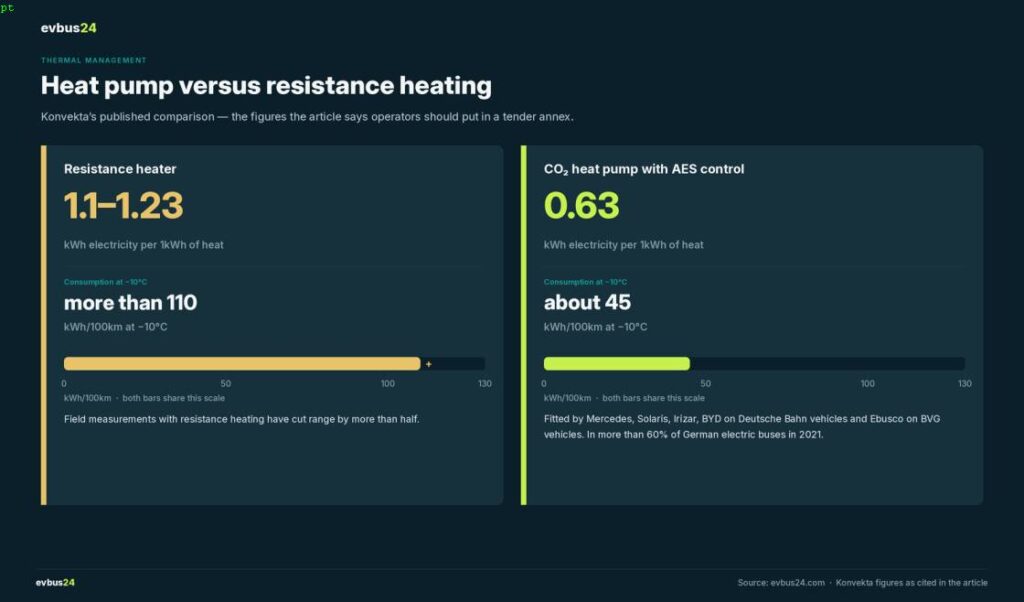
Konvekta’s CO₂ heat pump was in more than 60% of German electric buses in 2021. It is fitted by Mercedes, Solaris, Irizar, BYD on Deutsche Bahn vehicles and Ebusco on BVG vehicles.
Konvekta publishes the comparison operators should put in a tender annex:
|
Heating system |
Electricity per 1kWh of heat |
Consumption at −10°C |
|
Resistance heater |
1.1-1.23kWh |
more than 110kWh/100km |
|
CO₂ heat pump with AES control |
0.63kWh |
about 45kWh/100km |
Field measurements with resistance heating have cut range by more than half.
The 2026 double-deck version drops about 100kg on a new compressor and adds about 25% heating capacity.
MAN Lion’s City E
MAN took the same refrigerant and spent the development effort on staying in heat-pump mode deeper into the cold.
Winter tests in the far north were reported when the Lion’s City E CO₂ system became available in May 2022. They were aimed at using electric heaters only at very low ambient temperature.
The control software is written to pull ambient, component waste heat and the heat pump before it calls the resistance elements.
Yutong low-temperature heat pump
Yutong’s low-temperature heat pump is specified to keep working at −25°C, with heating energy cut by more than 30%. The claimed operating window is −40°C to 60°C.
On an extreme-heat run in Saudi Arabia the E11 Pro used 0.74kWh/km over 113km. The cabin went from 53.6°C to 23.6°C in 27 minutes on a 38,000kcal/h unit, with an air curtain at the middle door.
The YESS pack uses a nitrogen-inerting loop held under 1% oxygen. Yutong told visiting engineers the continuous nitrogen system costs under 1% of range.
VDL floor batteries and floor heating
VDL’s other thermal measure is architectural. Batteries sit in the floor, so the roof is free for a climate unit that does not compete with a rack of modules for airflow.
60% of cabin heat is delivered from the floor. Composite sides plus double glazing cut the load the heat pump has to meet.
VDL reaches the same winter result through vehicle design. Konvekta sells it as a bolt-on.
Smaller packs, more hours in service
Wrightbus’s StreetDeck Electroliner posted 0.69kWh/km on the Zemo-accredited ULEB cycle at UTAC, on a 454kWh pack.
The builder argued that efficiency can be spent on a smaller pack and more hours in service, rather than on a larger range. VDL made the same argument after the 546km run.
To sum up
These are the main facts about electric bus energy consumption:
-
a 12m electric city bus typically uses about 0.7-1.1kWh/km in temperate weather and can clear 1.5-1.7kWh/km in a hard winter with resistance heating
-
drag matters more at 40-50km/h on BHNS corridors than at a SORT 2 average of roughly 18km/h
-
wheel-arch fairings, wheel discs, roof fairings, composite sides and double glazing are the aerodynamic and thermal measures that reach production
-
drivetrain efficiency differs by a few percent, while climate control, mass and charge strategy move consumption by tens of percent
-
a CO₂ heat pump needs 0.63kWh of electricity per 1kWh of heat, against 1.1-1.23kWh for a resistance heater
-
a tender should ask for consumption with HVAC on at a declared ambient and passenger mass, in summer and at −10°C
Last but not least, the Heuliez wheel covers in Nice are an example of a small option that belongs in an energy specification.
Do you have a question about energy consumption of electric buses in your fleet? Contact us via the form below.